Quantum Computing
Draft page - placeholder text and images, to be refined.
Draft page - placeholder text and images, to be refined.
Quantum computing uses the principles of quantum mechanics - superposition and entanglement - to process information in ways that classical computers cannot. Instead of bits that are strictly 0 or 1, quantum computers use qubits that can represent combinations of both states at once, allowing certain classes of problem to be explored far more efficiently than on traditional hardware.
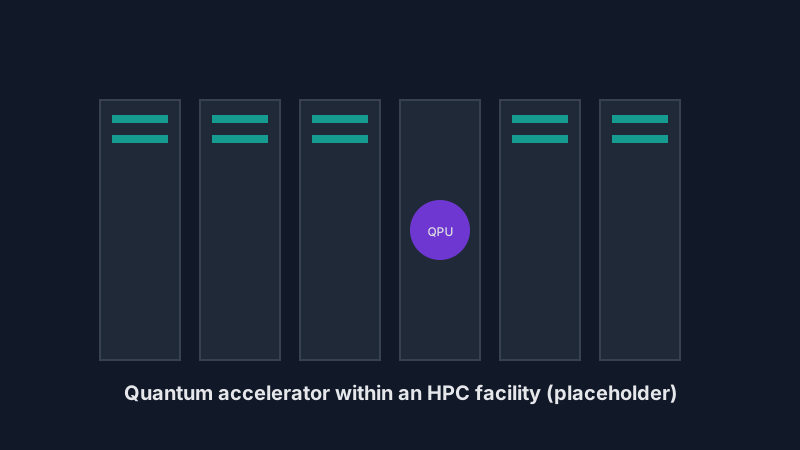
Placeholder: Quantum processors are not expected to replace classical High Performance Computing (HPC) - rather, they act as specialised accelerators alongside CPUs and GPUs. In a hybrid HPC facility, classical systems handle the bulk of a workload, while a quantum processing unit (QPU) is called on for specific sub-problems - such as optimisation, simulation of quantum systems, or certain classes of search - where it may offer an advantage.
As enterprise data and solution architectures increasingly need to account for emerging compute models, Holus Creative is tracking how quantum and hybrid HPC facilities may fit into future client architectures - particularly for data-intensive simulation, optimisation and research workloads.