Artificial Intelligence
Processing your data in new ways, generating new outputs for your advantage
Processing your data in new ways, generating new outputs for your advantage
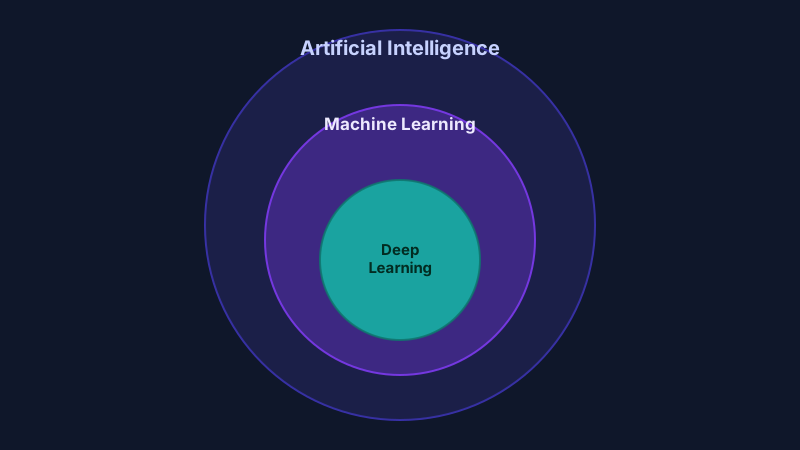
Artificial Intelligence (AI) is the broad field of building systems that can perform tasks which would normally require human intelligence. Machine Learning (ML) is a subset of AI in which systems learn patterns from data rather than following explicitly programmed rules. Deep Learning is, in turn, a subset of Machine Learning that uses layered neural networks and is behind many of the recent advances in language, vision and speech.
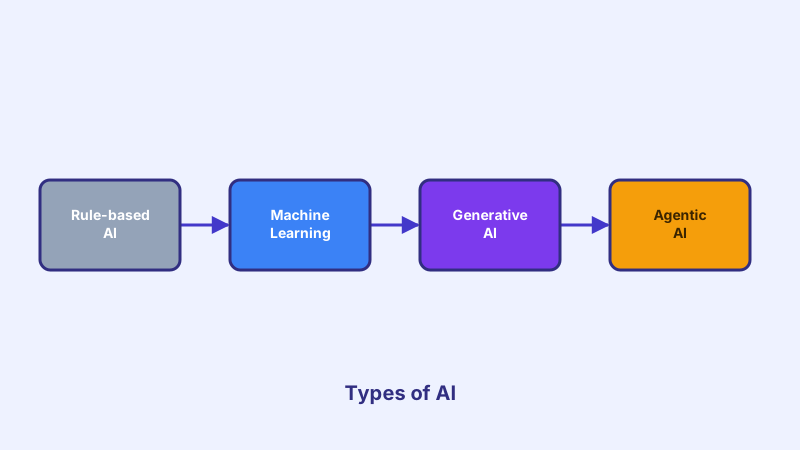
AI capability has evolved through several broad stages. Rule-based AI follows fixed, hand-written logic - systems often referred to as Expert Systems. Machine Learning moves beyond fixed rules, typically using supervised learning (learning from labelled examples), unsupervised learning (finding structure in unlabelled data) or reinforcement learning (learning through trial, error and reward). Generative AI builds on this to create new content - text, images, code and more based on a next-token prediction model. The most recent stage, Agentic AI, goes a step further again.
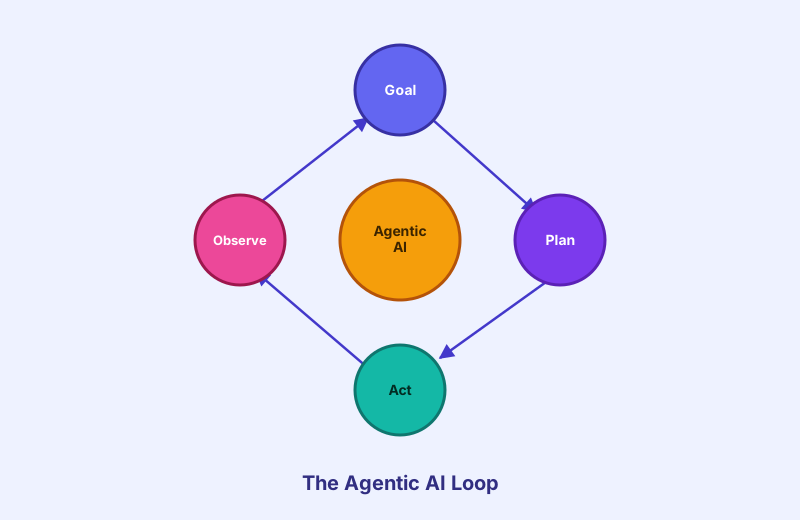
Agentic AI describes systems that don't just respond to a single prompt, but can pursue a goal with a degree of autonomy - planning a sequence of steps, taking actions (such as calling tools or other systems), observing the results, and adjusting their plan accordingly. Rather than one-shot input and output, an agentic system runs a loop: Goal, Plan, Act, Observe - repeating until the goal is met.
As AI moves from generating content to taking action, it increasingly touches enterprise data, systems and governance - the same areas covered by our Enterprise Data Architecture, Enterprise Architecture and Solution Architecture services. Holus Creative is tracking how agentic AI can be safely and effectively incorporated into client architectures so that these powerful tools can be deployed safely and for real enterprise benefit.